

The first thing I noticed was the circling. Juniper would walk a slow loop around her spot on the living room floor, nose down, tail still, then stop, then circle again. Some nights she did it four or five times before she finally lowered herself down with a grunt that I felt in my own chest. She is a 12-year-old golden retriever mix, about 64 pounds, and she has arthritis in both hips. The vet confirmed it when she was ten. Getting comfortable at night had become the hardest part of her day, and the Bedsure orthopedic bed we brought home last fall did more to change that than I expected. What follows is what we learned, in the order we learned it.
I spent 30 years as a nurse on orthopedic and rehab floors, so I know what a bad night does to a body that is already hurting. Pain and poor sleep feed each other. A dog who cannot settle wakes up stiffer, and a stiffer dog has a harder time settling the next night. You cannot cure arthritis with a bed. But you can change the quality of the sleep she gets, and that changes the whole day. Here is how we did it with Juniper, step by step, and what I would tell a friend watching their own dog go through the same thing. None of this is complicated. Most of it is paying attention and making small changes that add up.
The bed that ended Juniper's bedtime circling
The Bedsure orthopedic bed has a 4-sided bolster design and a 6.5-inch egg-foam base. It gives a 64-pound dog somewhere to lean and somewhere to sink, without bottoming out onto the floor. It is the bed she chooses every single night now.
Amazon Check Today's Price on Amazon →Step 1: Talk to your vet before you change anything
The first step is not picking a bed. It is getting a clear answer about what is going on. Juniper's stiffness started as a slight pause before she stood up from a nap. By the time we saw our vet, she was also slow on the three wooden steps down to the back yard. The vet took x-rays, confirmed arthritis in both hips, and talked us through pain management options, including weight, gentle exercise, and medication. Every dog is different, and what helped Juniper might not be right for yours. That visit was the turning point, because it gave us a plan instead of a worry.
Ask your vet what they want the bed to do. In our case, the goal was joint support and warmth, not a cure. We wanted a surface that would let Juniper's hips rest in a neutral position instead of pressing into a hard floor. That gave me a clear list of what to look for: thick foam, a washable cover, and sides she could lean against without having to climb over. We also talked about what to expect at night, because arthritis pain often gets worse when a dog has been lying still for a while.
If your dog is already on pain medication or joint supplements, keep the bed conversation separate from the medication conversation. The bed is part of the plan, not the whole plan. And if your dog is not diagnosed yet, start with the vet. A dog who suddenly struggles to get up deserves a medical check, not just a softer place to land. Ask your vet whether a bolster style or a flat style would suit your dog better. We chose a bolster bed because Juniper likes to rest her head on something when she sleeps.
Step 2: Put the bed where she already sleeps
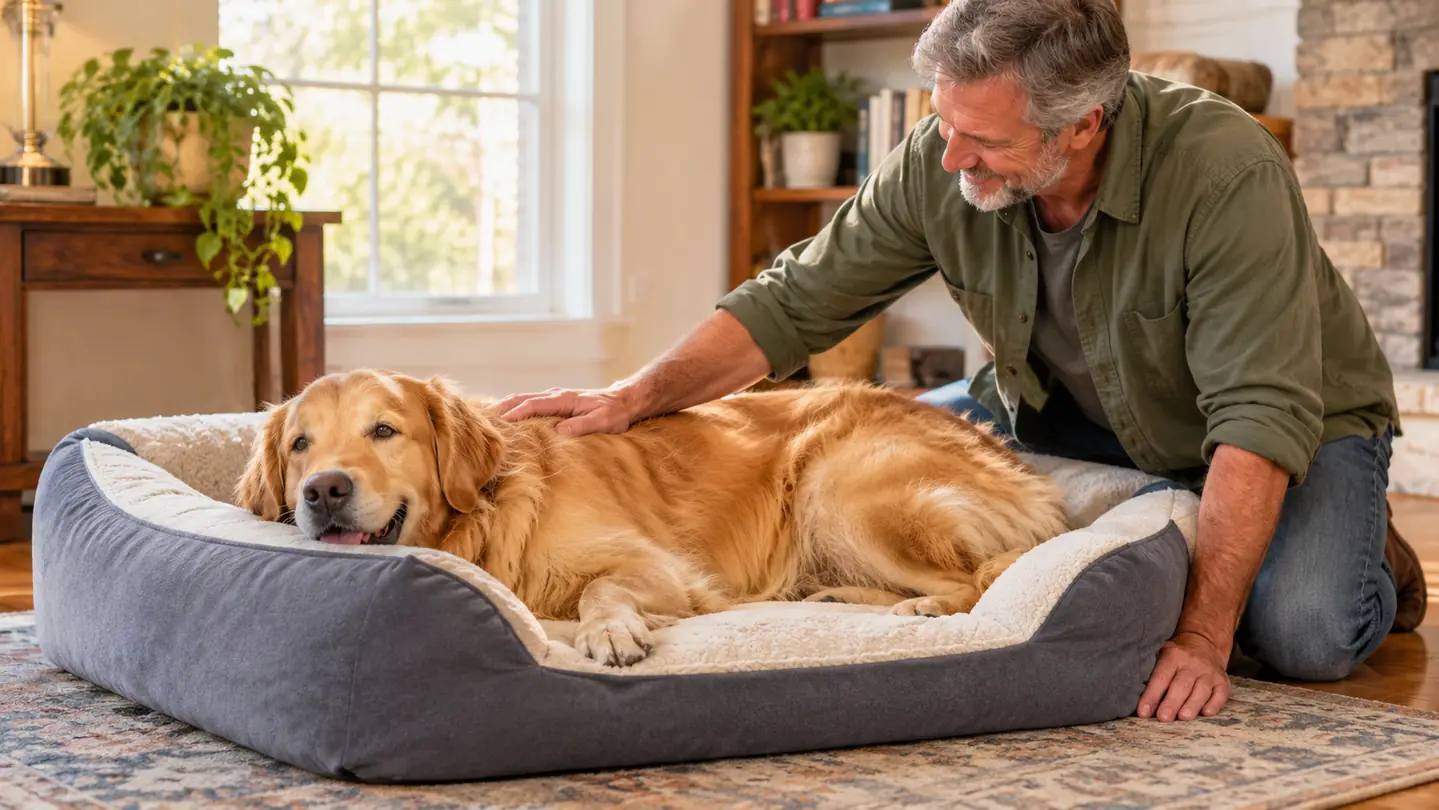
Juniper had a favorite spot in the hall, right where the hardwood met the rug, even though it was the hardest surface in the house. Dogs with arthritis often choose a spot for the view, the breeze, or the habit, not for the comfort. So I did not try to move her to a new corner. I put the Bedsure bed in her spot. The first night she stepped onto it, turned around twice, and lay down like she had been using it for years. She had always liked that corner because she could see both doors. I was not going to take that away from her.
Think about access. The bed is 38 inches long, 28 inches wide, and 6.5 inches thick, so it sits low enough for a large dog to step onto without a jump. Place it away from stairs she would have to climb and away from cold drafts. We put ours in the hall where Juniper could still see the kitchen and the front door. Dogs sleep better when they are not worrying about missing something. The 6.5-inch thickness matters more than it sounds like it should. It is enough foam to cushion a 64-pound dog, but low enough that she does not have to launch herself up and down.
If you have more than one pet, give the bed a moment to become the older dog's bed. Pickles, our cat, inspected it on day one and moved on. Juniper claimed it by the end of the week. If your dog is hesitant, put a worn t-shirt of yours on the bed so it smells familiar, and let them discover it on their own schedule. A bed that feels like a punishment will sit empty no matter how good the foam is.
Step 3: Help her in and out at first
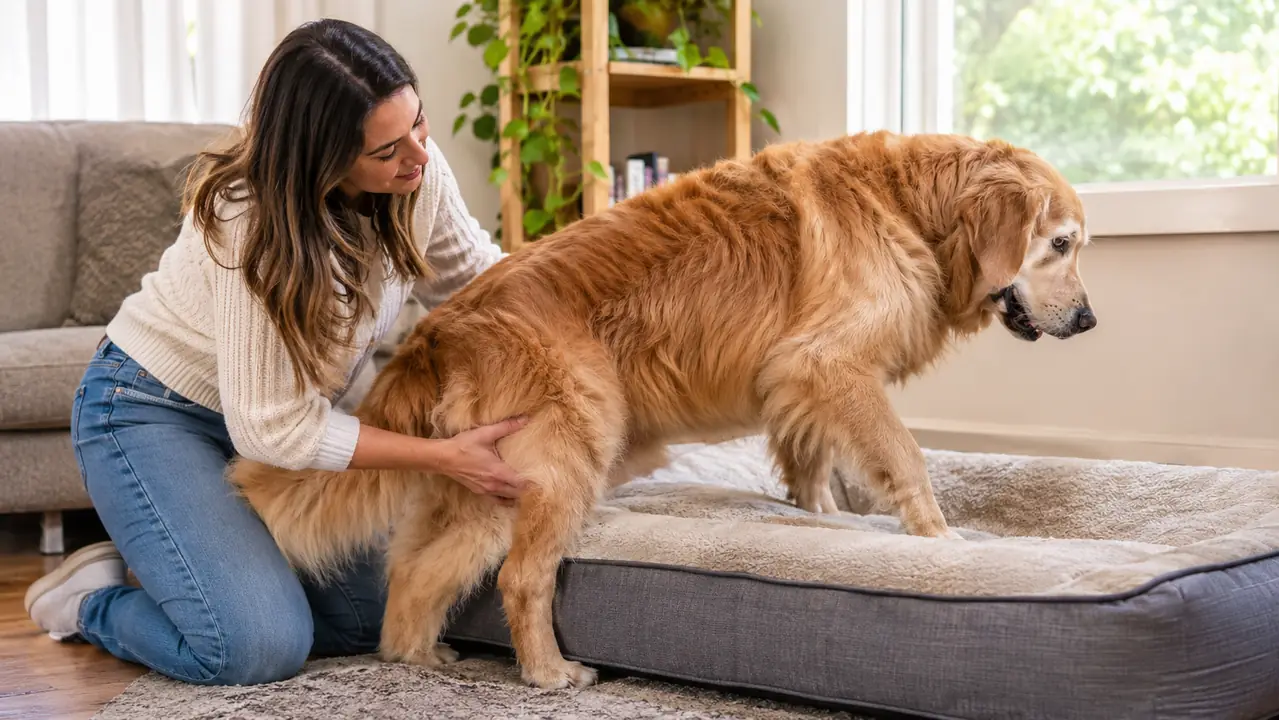
On the rehab floor, the rule was never to grab a patient under the arms and haul. You support the hips, you keep the spine straight, and you let the patient do as much as they can. The same applies to a dog with hip arthritis. For the first two weeks, I knelt beside the bed and slid one hand under Juniper's chest and one under her belly, right in front of her back legs, and lifted just enough to take the weight off her hips while she stepped up. The goal was to let her do the stepping while I did the steadying.
Getting out is often harder than getting in. Juniper would stand at the edge of the bed and hesitate, working up the courage to step down onto the hardwood. I used the same two-hand support on the way out, and I put a rug beside the bed so her feet had traction. The floor around the bed mattered just as much as the bed itself. I also kept her nails trimmed during those first weeks. Shorter nails gave her better grip on the hardwood, and better grip meant more confidence.
Do not rush this. A dog who is afraid of falling will stop using the bed entirely. If your dog hesitates, go back to luring with a treat and praise. Let them see that the bed is a safe place. Juniper needed about ten days before she stopped waiting for me and started using the bed on her own. Patience is not just a kindness here. It is the practical fastest way to get a dog using a new bed.
Step 4: Keep the bed clean and the foam supportive
A bed that smells like the dog is a bed the dog will use. A bed that smells like stale dog is a bed you will have to fight to keep in the house. The Bedsure bed has a removable cover, which is the feature I would not give up now. Once a week I take the cover off, wash it in the machine on cold, and let it air dry. The bed is waterproof, so accidents and drool do not soak into the foam. I learned this the hard way with a different bed years ago, one that could not be washed and ended up in the trash.
The foam itself is the part that does the work. This bed uses CertiPUR-US certified polyurethane foam, and the included egg-foam layer is what gives it that soft-but-supportive feel. A 64-pound dog sinks in just far enough to take pressure off her hips, but she does not bottom out onto the floor. That is the balance you are looking for: enough give to cushion, enough support to hold. The bed is also OEKO-TEX certified, which mattered to me because Juniper presses her nose into the fabric every single night.
Air the bed out when you wash the cover. Foam holds moisture and odor, so I stand the base in the sun for an hour before I put the clean cover back on. The cover is also easy to spot clean between washes, which matters when a dog comes in from the yard with muddy paws and decides the bed is the best place to dry off. If the cover gets truly dirty, the whole thing comes off and goes in the wash, which is the difference between a bed that lasts and a bed that gets thrown away.
Step 5: Watch how she sleeps and adjust
The real test of a bed is what the dog does at 2 a.m. Before the Bedsure bed, Juniper would circle, lie down, get up, circle again, and sometimes end up sleeping on the floor next to the bed. Now she settles after two or three turns and stays down. She stretches out on her side, which is the position that lets her hips rest most naturally. I hear her snoring in a way I did not hear before. That is the whole point of an orthopedic bed, as far as I am concerned. Not a fancy label, but a dog who stays asleep.
Keep watching even after the bed is working. If your dog starts circling more than usual, or gets up and moves to the floor, that is information. It can mean the pain is worse, the medication needs adjusting, or something else has changed. The bed is a tool for spotting change, not a reason to stop paying attention. Write it down if that helps. I keep a small notebook in the kitchen drawer.
I keep a simple mental log: how many times she circles, whether she stays down through the night, how she is when she first stands up in the morning. When I describe her nights to our vet, that information matters more than my impression. A bed cannot replace a vet visit, but it can give you a clearer picture of what is happening between visits. Over time, that log also showed us what was working, which is how we knew the bed was worth keeping.
What Else Helps
The bed did the most visible work, but it was not the only change we made. I put rugs down on the hardwood in the hall and living room so Juniper does not have to walk on slippery floors. Slipping is hard on arthritic hips, and a little traction goes a long way. I also added a ramp over the three porch steps, which she uses more than I expected. The ramp took an afternoon to build, and she uses it every single time she goes out.
Gentle, consistent movement helps too. Short walks in the cooler parts of the day, keeping her at a healthy weight, and warm, soft places to rest all make her joints happier. I trim her nails regularly because long nails change the way she stands and make her more likely to slip. And I keep her bed in the part of the hall that stays warmest, away from the draft from the front door. I also moved her food and water bowls to a spot she could reach without crossing the slippery hall. Warmth and softness together are a powerful combination for a stiff old dog.
One more thing: keep paying attention after the bed is in place. If your dog starts sleeping on the floor again, do not assume the bed has failed. Check for a draft, a wet spot, or a cat who has claimed it. One afternoon Pickles curled up on it, and Juniper let her have it for a while. By dinner, Juniper was back in her spot, and Pickles had moved on to the windowsill.
Juniper used to circle for five minutes before lying down. Now she turns twice, stretches out on her side, and stays down until morning.
Give your dog the same good nights
If your dog is stiff in the morning, slow on the steps, or circling before bed, the Bedsure orthopedic bed is the place to start. It will not cure arthritis, but it will give your dog a supportive, washable place to sleep, and that changes everything about the day that follows.
Amazon Check Today's Price on Amazon →