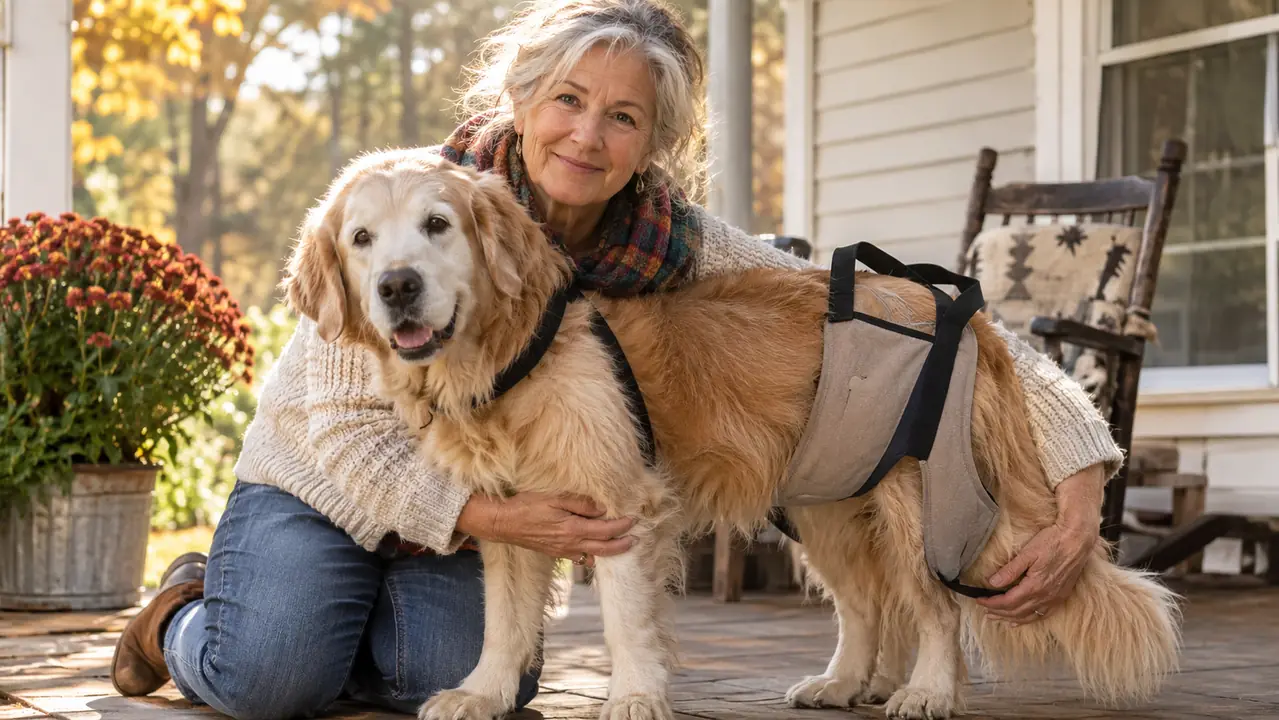
The first time Juniper's back legs gave out, we were at the bottom of the back porch steps. She is a 12-year-old golden retriever mix, about 64 pounds, with arthritis in both hips that our vet diagnosed when she was around 10. She had been stiff getting up from naps for a while, and slower on those three wooden steps, but that morning she just stopped. Her front end kept going and her back end did not follow. She stood there, front feet planted, rear legs trembling, and looked back at me like I might have an answer.
I spent 30 years as a registered nurse on orthopedic and rehab floors, so my first instinct was to think about what was actually happening. Her hips were stiff and probably sore. Her rear muscles were weaker than they used to be. And every time she tried to push herself up, she was asking those weak back legs to do all the work. What she needed was a little help taking her own weight, not someone grabbing her or dragging her. That is what a lift harness does, and the LOOBANI Dog Lift Harness for Large Dogs is the one we settled on after trying a few other ideas first. It lets you support the hindquarters while the dog does the walking. This guide is the exact routine I use with Juniper, step by step, so you can see whether it might help your dog too.
The lift harness that keeps Juniper moving
The LOOBANI Dog Lift Harness for Large Dogs is the one we keep by the back door. It is a nylon sling with soft, sheepskin-like padding and carrying handles, and it comes with a storage bag. You can check today's price on Amazon and see the current sizing options.
Amazon Check Today's Price on Amazon →Step 1: Talk to your vet before you add anything
I am not a vet, and I am not going to tell you to skip yours. When Juniper first started hesitating at the porch steps, we did not reach for a harness right away. We went to our vet, who checked her hips, confirmed the arthritis, and talked with us about pain management, joint supplements, and what was realistic for a 64-pound dog her age. The harness came up in that conversation as a tool for taking weight off her back legs during the day, not as a treatment for the arthritis itself.
That distinction matters. A lift harness is not a cure and it is not a substitute for veterinary care. It is a piece of equipment that makes everyday movements easier while you and your vet work on the underlying problem. If your dog is showing new weakness, get a diagnosis first. If the weakness came on suddenly, call your vet the same day. Sudden rear-leg weakness can be a sign of something more urgent, and I would rather you hear that from a professional than from me.
Before we bought the LOOBANI, I tried two things that did not work. The first was a towel folded under her belly. It bunched up within three steps, and I had to stop, re-fold it, and start over, which frustrated both of us. The second was simply helping her by hand, one arm under her chest and one under her rear. That worked for getting her up, but it did not give me any control on the steps, and bending down that far hurt my own back after a week. What I wanted was something with handles I could hold at a comfortable height. When I described what I had been doing, our vet said a lift harness was worth trying before we spent money on anything bigger.
Step 2: Get the harness on the floor before you need it
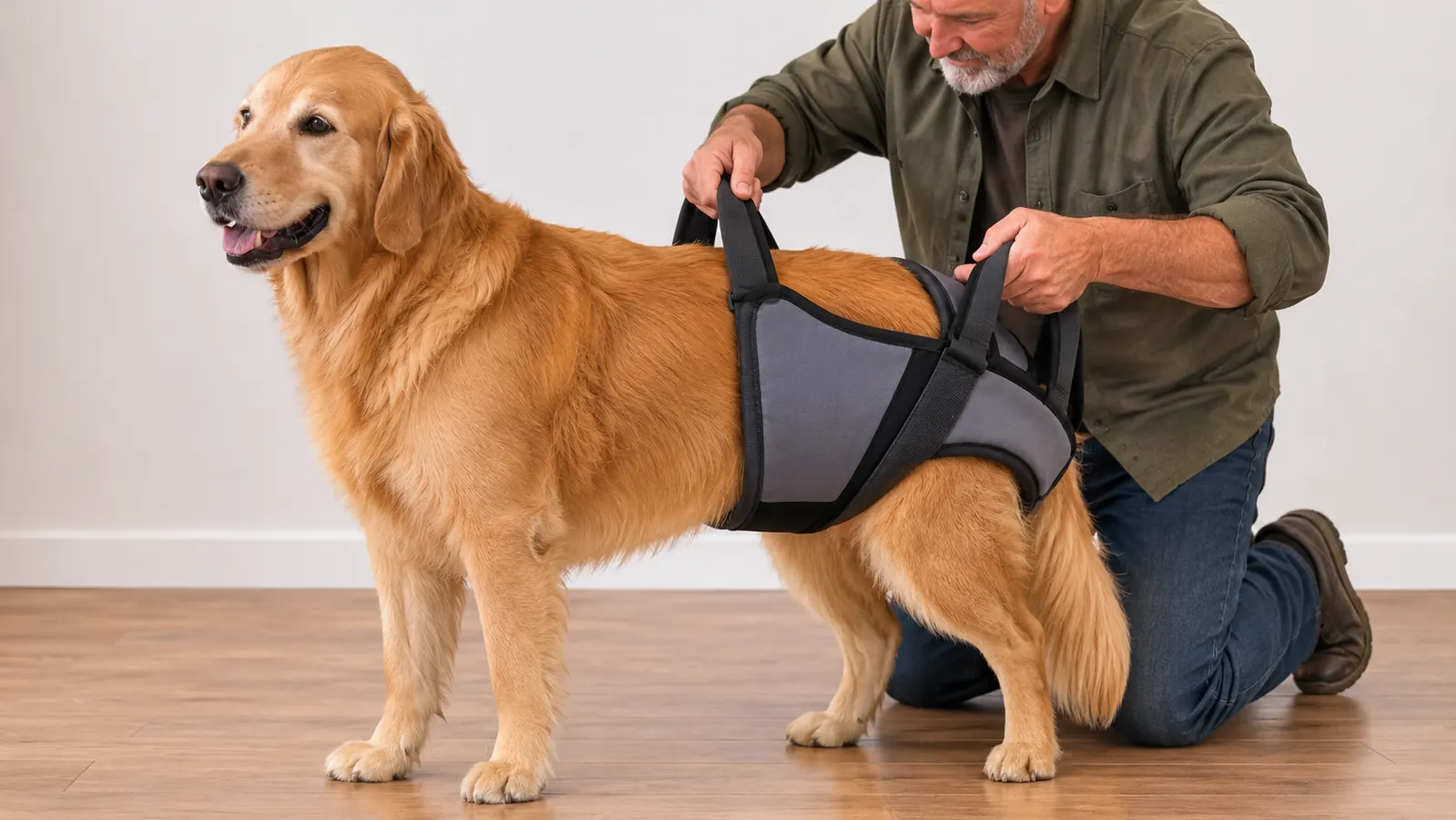
The LOOBANI harness is simple: a padded sling with two handles, one on each side, and a drawstring closure to adjust the fit. It weighs 14.88 ounces, so it is light enough to carry in the storage bag that comes with it. The material is nylon and the whole thing is machine washable, which matters when you use it outside on damp mornings. Before you ever need it in a hurry, lay it flat on the floor and get familiar with which end goes where. You do not want to be figuring that out while your dog is wobbling.
The way I do it with Juniper: I place the sling on the floor behind her, then ask her to step backward into it, one back foot at a time. If she is having a low-energy day, I simply slide the sling under her hindquarters while she stands. The padded part sits under her belly, just in front of her back legs, and the handles come up on either side of her rear. The drawstring lets me snug it so it stays put without digging in. It takes about a minute once you have done it a few times.
The first time I fitted it, I left the drawstring too loose. The sling slid forward and bunched up behind her ribs, and Juniper took two steps and stopped to look at it. I loosened the closure, slid the padded part back so it sat just in front of her back legs, and snugged the drawstring until the sling stayed put without pressing into her. That adjustment took about two minutes, and it turned a harness she noticed into a harness she ignored. I also learned to put it on before she needed it. If I wait until her back legs are already buckling, she is anxious and hard to position. If I slide it under her while she is still calm, she stands there like it is part of the morning routine.
Step 3: Lift with your legs, not your back
Here is where my nursing background kicks in. When you support a dog with a lift harness, you are doing a mini patient transfer, and the same rules apply. Stand close to the dog. Keep your back straight. Bend at the knees. Take one handle in each hand, and lift only enough to take the edge off her weight. You are not trying to hoist her off the ground. You are trying to give her back legs a break so she can use the strength she still has.
With Juniper, I aim to support maybe a third of her weight on a bad day and less on a good day. The goal is for her to feel stable, not suspended. When she stands up from a nap, I lift gently as she pushes. When we go down the porch steps, I keep a light tension on the handles so her rear end does not drop. When we are out without the ramp and she needs to get into the back of the SUV, I lift a little more firmly and let her front legs do the climbing. She does the work. I just even out the load.
The morning that sold me on the routine was a Tuesday in early March. Juniper had slept hard and came out of her nap stiff. She pushed with her front legs twice and could not get her rear end underneath her. I slid the harness under her, took a handle in each hand, and lifted maybe a quarter of her weight. She stood, shook herself, and walked straight to the back door. That whole thing took less than a minute. On the hospital floors we were taught to let patients do as much as they could themselves and to help only with the part they could not manage. The harness works the same way. When I lift too much, Juniper stops trying. When I lift too little, her back legs buckle. The right amount is the amount that lets her push off and feel steady.
Step 4: Use it for the movements that are hardest
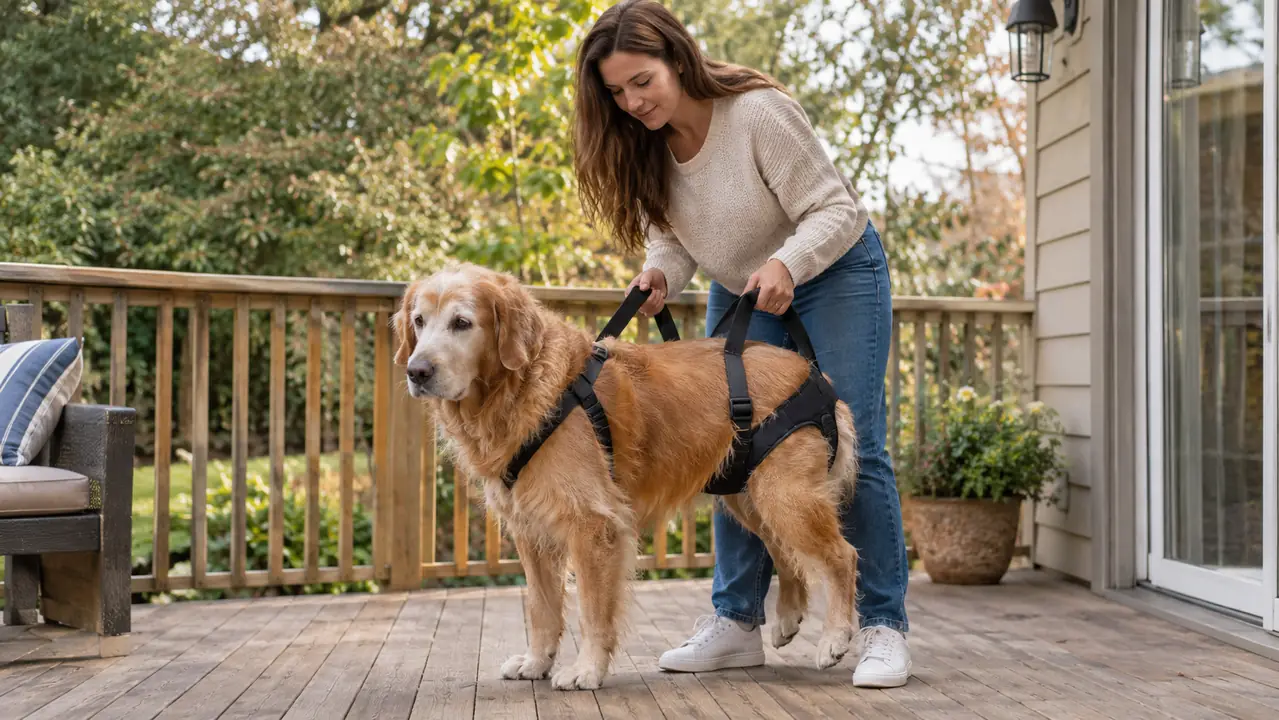
You do not need to keep the harness on your dog all day. In fact, you should not. We use it for the specific moments Juniper struggles with: getting up from her bed after a long nap, going down the back porch steps, stepping up into the SUV, and sometimes getting onto the couch when she has decided she really wants to be up there. For everything else, she moves on her own. Keeping the harness for the hard moments means she stays stronger longer, because she still uses her legs for the easy stuff.
The LOOBANI listing describes it as a support hip sling for standing up, going up and down stairs, getting in and out of vehicles, and getting onto furniture. That matches exactly how we use it. I keep it in the storage bag by the back door in warm weather and in the car during winter, because the porch steps are slick when they are wet. Having it within reach means I actually use it instead of telling myself she will manage this time.
The SUV is the hardest one. The rear hatch is high enough that Juniper has to jump to reach it, and at 64 pounds with arthritic hips, jumping is exactly what she should not be doing. I open the hatch, slide the harness under her, and lift her rear end while she puts her front paws on the bumper. She climbs, I guide, and nobody lands wrong. Coming home, I do the same thing in reverse, holding her rear end as she backs out. The porch steps are only three, but they are the ones she uses every time she needs the yard. On wet mornings I used to hold my breath watching her. Now I walk beside her with one handle in each hand and light tension on the sling. Her front feet do the stepping and I keep her rear end level so she does not drop hard on the last step.
Step 5: Watch how your dog responds and adjust
The first time I used the harness with Juniper, she stood still, looked back at the handles, and then just walked. That was the moment I knew it was going to work. But every dog is different, and the first few tries might be awkward. Some dogs need a treat to stand still while you position the sling. Some need you to be slower. Some will let you know, very clearly, that they would rather you did it a different way. Listen to them.
I also watch for signs that we are pushing too hard. If Juniper is panting more than usual, if she is reluctant to get up at all, or if she seems sore after a walk, we back off and I talk to our vet. The harness makes movement easier, but it does not tell you how much movement is right for your dog on any given day. That is a judgment call you make together with your vet, based on what you see at home.
What Else Helps
The harness is one piece of the puzzle, not the whole picture. What has helped Juniper most is the combination of things our vet recommended: keeping her at a healthy weight, short and frequent walks on soft ground, rugs on the hardwood floors so she does not slide, and a consistent routine for pain management and joint support. I also learned to give her a little more time to get up in the morning. She is not being stubborn. She is just stiff, and a few extra seconds makes a real difference.
If your dog is struggling with weak back legs, start with your vet, then add the things that make daily life easier. For us, the LOOBANI lift harness is the tool that lets Juniper keep doing the things she loves: following me to the kitchen, sniffing around the back yard, and riding in the car to see the ocean. It does not fix her hips. It gives her a hand, which is what all of us need sometimes.
She does the work. I just even out the load. That is what a lift harness is for.
Give your dog a hand when the back legs need it
The LOOBANI Dog Lift Harness for Large Dogs is machine washable, comes with a storage bag, and is simple enough to use on a bad morning. Check today's price on Amazon to see whether it is the right fit for your dog.
Amazon Check Today's Price on Amazon →