When Juniper started sliding on our hardwood floors, I looked at two fixes: DOK TigerToes dog socks, which cover the whole paw, and stick-on toe grips, which attach to the nails. I tried both with her over several weeks. If you want the short answer: the DOK socks are what I kept reaching for, and they are what I would buy again.
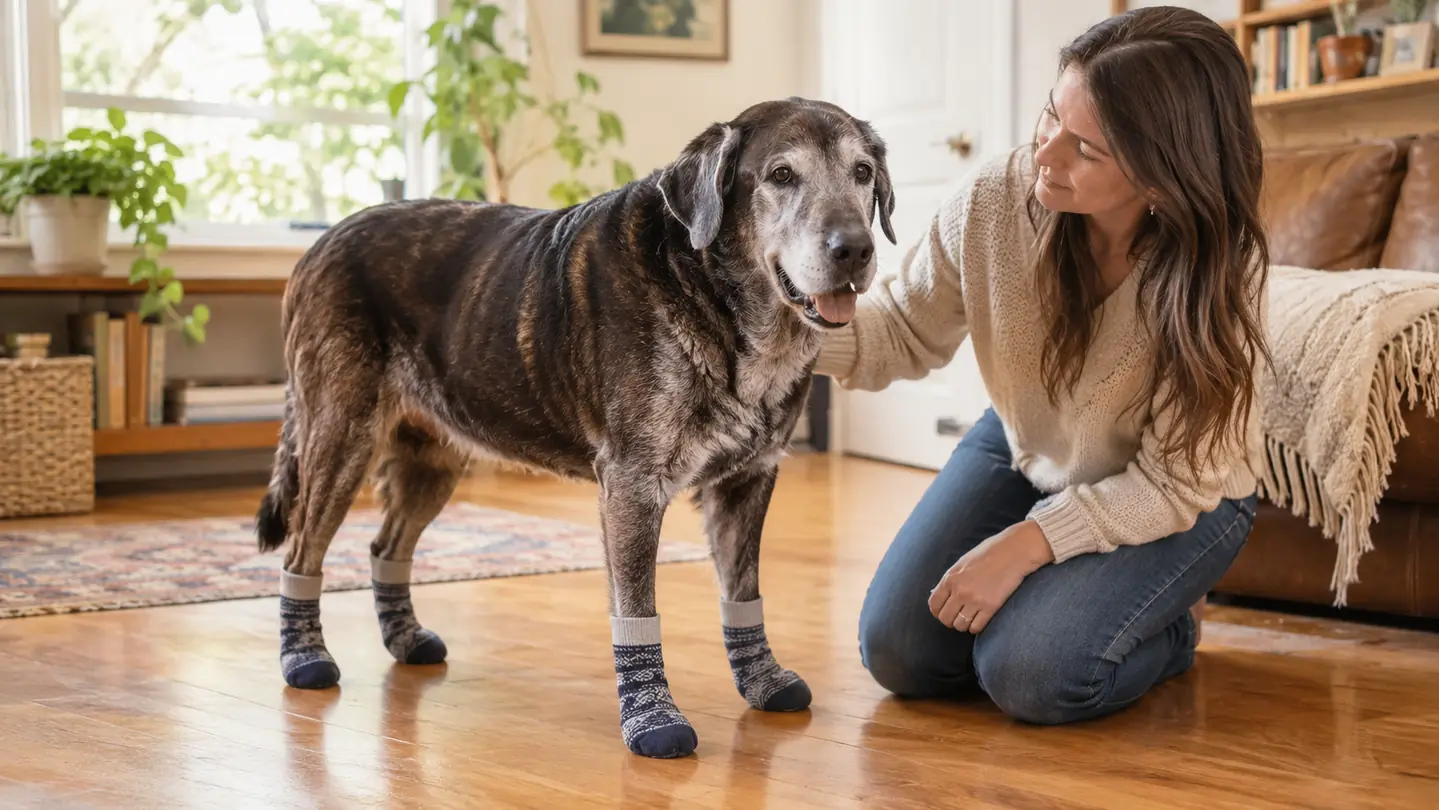
Juniper is a 12-year-old golden retriever mix, about 64 pounds, with arthritis in both hips. She was diagnosed around age 10. The first sign was stiffness after naps, then hesitation at the back porch steps, then a wide, careful stance on the living room floor. Our vet said traction matters for dogs her age, so I started testing the two most common products I kept reading about.
The moment that pushed me to act was a Tuesday morning in late January. Juniper tried to turn around on the hall floor to follow me into the kitchen, her back feet slid out from under her, and she landed hard on her hip. She got up right away and acted fine, but I did not want to watch that happen again. I ordered the DOK TigerToes socks and a pack of stick-on toe grips the same week so I could compare them on the same floors, with the same dog, over the same stretch of weather.
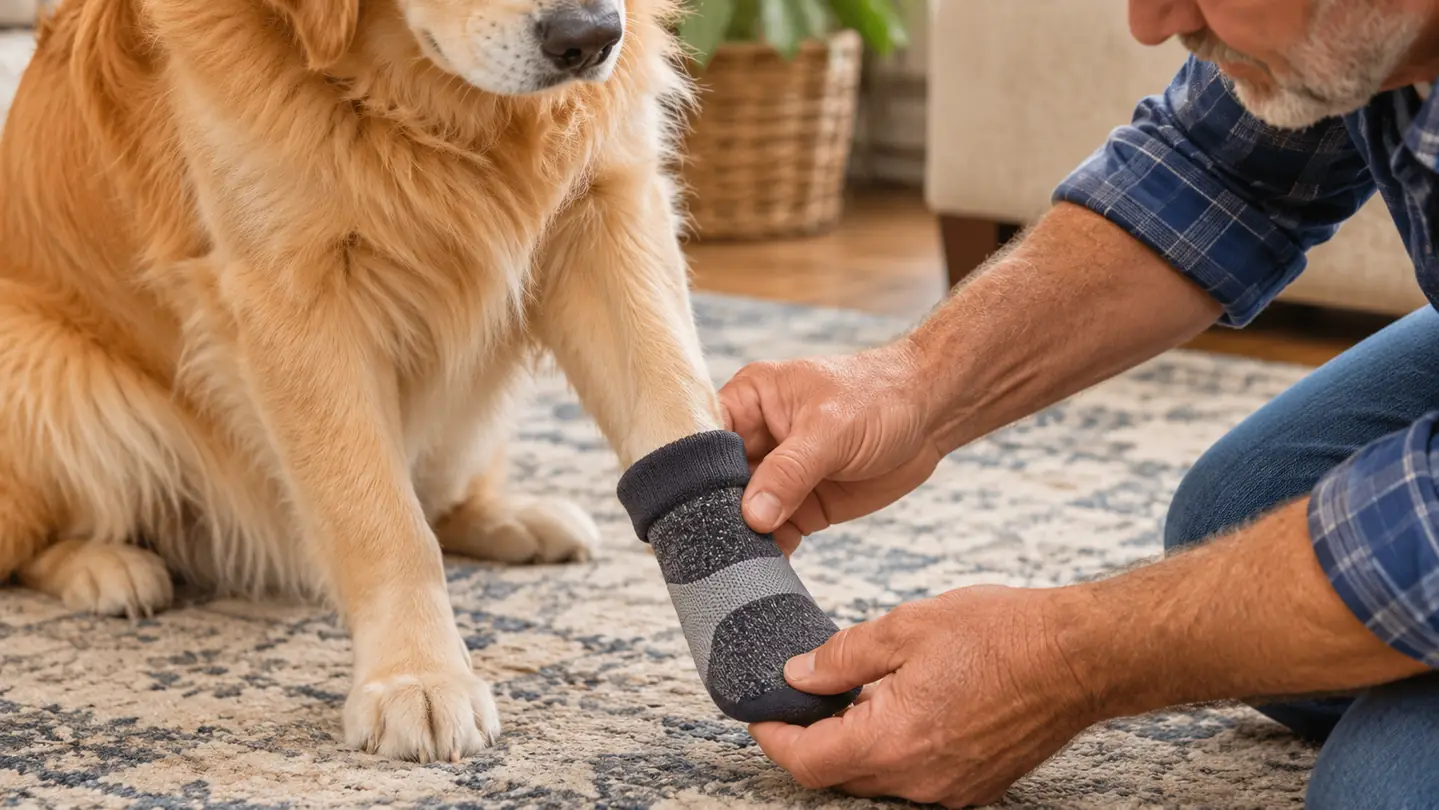
Before I started, I measured Juniper's front paw with a soft tape measure while she was lying down. The DOK large size fits paws 2.5 to 2.8 inches, and her front paw measured about 2.7 inches, so the large was the right call. The pack comes with four socks, which meant I could cover all four paws and still have a matching set. That detail mattered to me, because a product that only covered the front paws would have left her back end sliding anyway.
To keep the test fair, I used the DOK socks for the first two weeks and the toe grips for the second two weeks, with a two-day break in between so Juniper's paws could rest. I kept a little notebook on the kitchen counter and wrote down anything I noticed: slips, hesitation, chewing, how long it took to get them on, how long they stayed on. That notebook is where most of what I am sharing with you comes from.
| DOK TigerToes Dog Socks | Stick-On Toe Grips | |
|---|---|---|
| How it works | Extra-thick grip pads cover the bottom of the paw, so traction stays even if the sock twists | Small adhesive grips attach to the nails only |
| Best for | Senior dogs on hardwood, tile, and laminate, plus licking and paw protection | Dogs that tolerate nail handling and keep the grips on |
| Fit | Large fits paws 2.5 to 2.8 inches; hook-and-loop closure plus pull-on | One size per nail; must match grip to nail width |
| What's in the pack | 4 socks, one for each paw | Grips for individual nails; replacement packs needed as they wear off |
| Coverage | Full paw coverage, including the top of the foot | Nails only; paw pads still meet the floor |
| Setup | Slip on and tighten; no trimming or gluing | Trim nails, clean them, apply adhesive, and hold still |
| Maintenance | Machine washable cotton and nylon | Grips wear off and must be reapplied every few weeks |
| Licking protection | Covers the paw, so it is harder for the dog to lick irritated spots | Leaves the rest of the paw exposed |
| Outdoor use | Indoor and outdoor protection | Best indoors; moisture can loosen the adhesive |
| Paw pad contact | Grip pad sits between the paw and the floor | Paw pads touch the floor directly, which some dogs prefer |
| How noticeable | Full socks on all four paws | Nearly invisible from across the room |
| What the dog felt | Juniper forgot she was wearing them after a few minutes | Juniper chewed at her toes until the grips came off |
| Bottom line | A traction fix and a paw cover in one product I did not have to reapply | A fine idea that did not survive contact with my dog |
Where DOK Wins
The DOK TigerToes socks won on the one thing I actually needed: traction that stayed put. The bottom of the sock has an extra-thick grip pad, and the company engineered it so the grip still works even if the sock twists while the dog is walking. I saw that happen with Juniper on the first day. The sock turned slightly on her right front paw and she still crossed the living room without the sideways slide she had before. That one feature made me trust the design.
The first full day told me most of what I needed to know. I put all four socks on Juniper on a Saturday morning, right after her breakfast. She stood there for a second with her front feet wide apart, which is normal for a dog that has never worn socks. Then she took a step, heard the soft sound of the grip on the wood, and just kept going. By the time we reached the back door she was walking at her usual pace. I timed her crossing the living room before and after: it went from a slow, careful shuffle of about ten seconds to a normal walk of about six, and more importantly, there was no moment where her back feet shot out sideways.
I also tested the twist claim on purpose. On the third day I let one of the socks sit twisted on her right hind paw instead of straightening it. She walked the length of the hall, turned around in the kitchen doorway, and came back without a single slip. That was the moment I stopped worrying about the socks bunching up mid-walk, which had been my biggest concern with a sock-style product in the first place.
The washing machine test came a week later when Juniper stepped in mud on the back porch steps. I peeled the socks off, threw them in with a load of towels on cold, and air dried them. They came out looking the same and fitting the same. The cotton and nylon fabric held up, and the hook-and-loop closures still grabbed the way they did on day one. For a product that sits between a dog's paw and the floor all day, that kind of durability matters.
The other thing I noticed was how the socks handled the three wooden steps down to the back yard. Those steps were Juniper's slowest spot. With the socks on, she still took them one at a time, but she stopped pausing at the top to brace herself. The extra-thick grip gave her enough confidence to commit to each step, and that small change made our whole routine easier.
One benefit I did not expect was the licking protection. Juniper has a spot on her left front paw that she licks when she is bored, and the sock covered it completely. Within a few days the spot started to calm down because she simply could not reach it. The DOK listing mentions paw protection and preventing licking, and I can confirm that part of the claim from our own experience. It was like getting a second product for free.
Where Stick-On Toe Grips Win
I will be fair to the toe grips, because they do have a place. They are less visible than a sock, so a dog that hates anything on its feet may accept them more easily. They also let the paw pads touch the floor directly, which some dogs prefer for balance. And if your dog has short, well-kept nails and does not chew at its feet, the grips can be a low-profile option for a dog that only slides on one particular stretch of floor.
The application process is where the toe grips and I parted ways. The instructions that came with ours called for clean, dry nails, which meant a bath or at least a thorough paw wipe first, then a careful trim, then holding each paw still while the adhesive set. Juniper has always been sensitive about her feet. She pulled her paw back three times during the first nail trim, and by the time I had the grips on two toes, she was done cooperating. I managed to finish the job by bribing her with peanut butter, but it took the better part of an hour for all four paws.
They lasted about three days. On the third evening I found two grips on the living room rug and one on the kitchen floor. The fourth was still on her nail but hanging loose. I reapplied the set that night, and this time Juniper chewed at her toes until she had pulled every last one off. I woke up at 2 AM to the sound of her licking and went out to find the carpet by her bed covered in little rubber dots. That was the end of the experiment.
There was one more problem I did not expect. The grips came off at different times, so I was constantly checking Juniper's paws to see which ones were still on. That meant bending down to inspect her feet several times a day, and every time I found a missing grip I had to decide whether to reapply it right then or wait until the evening. It turned our simple morning routine into a constant maintenance chore, which is the last thing a tired owner of a senior dog needs.
Looking back, the toe grips asked Juniper to do things she cannot easily do anymore. She has arthritis in both hips, so standing still with one leg held up while I fussed with her nails is genuinely hard for her. She also has a habit of licking her paws when she is anxious, and the grips gave her something to pick at. None of that makes the product bad. It makes it a poor match for a stiff, sensitive senior dog, which is exactly the kind of dog I was trying to help.
Give your senior dog the grip that actually stays put
The DOK TigerToes socks are the ones I kept reaching for with Juniper. Extra-thick grip, full paw coverage, and machine washable.
Amazon Check Today's Price on Amazon →
Who Should Buy Which
Buy the DOK TigerToes socks if your dog slides on hardwood, tile, or laminate and needs traction right away. They are especially good for senior dogs with arthritis, dogs that lick or chew their paws, and dogs that need paw protection indoors and out. The large size fits paws 2.5 to 2.8 inches, they are machine washable, and the extra-thick grip keeps working even when the sock twists. That last point matters more than you would think once you watch a stiff dog cross a slick floor.
I would also buy the DOK socks if your dog has any kind of paw irritation, because the full coverage does double duty. The pack comes with four socks, so you can cover all four paws, and the pull-on plus hook-and-loop closure means you can adjust the fit without wrestling your dog into anything. If your dog only slides on one stretch of floor, you can even use just the two back socks and save the other pair for when the first ones wear out.
Consider stick-on toe grips only if your dog tolerates nail handling, keeps its feet alone, and only slides a little. They are lighter and less noticeable, and they can work for a calm dog on a small patch of floor. But if your dog is anything like Juniper, the application routine and the reapplication schedule will wear you both out. I would start with the DOK socks, see how your dog does, and only try the grips if the socks bother them.
Before you buy anything, I would say the same thing I tell every family I worked with as a nurse: check with your vet first. Juniper's arthritis is managed with her regular plan, and our vet was the one who suggested working on traction in the first place. A product like this helps with the slipping, but it does not treat the underlying joint pain. If your dog is suddenly sliding or hesitating, have them looked at before you assume it is just the floors.
One more thing I would tell any owner in the same spot: give whichever product you choose a full week before you judge it. The first day is not a fair test. Juniper needed about three days to stop checking her feet, and by the end of the week the socks were just part of her morning routine. If you are still fighting with the product after seven days, that is your answer. For us, the answer was clear, and it is the product I would order again without hesitation.
The socks I kept on Juniper's paws
If your dog is sliding and you do not want to fight with adhesive, the DOK TigerToes socks are the practical pick. See today's price on Amazon.
Amazon Check Today's Price on Amazon →