
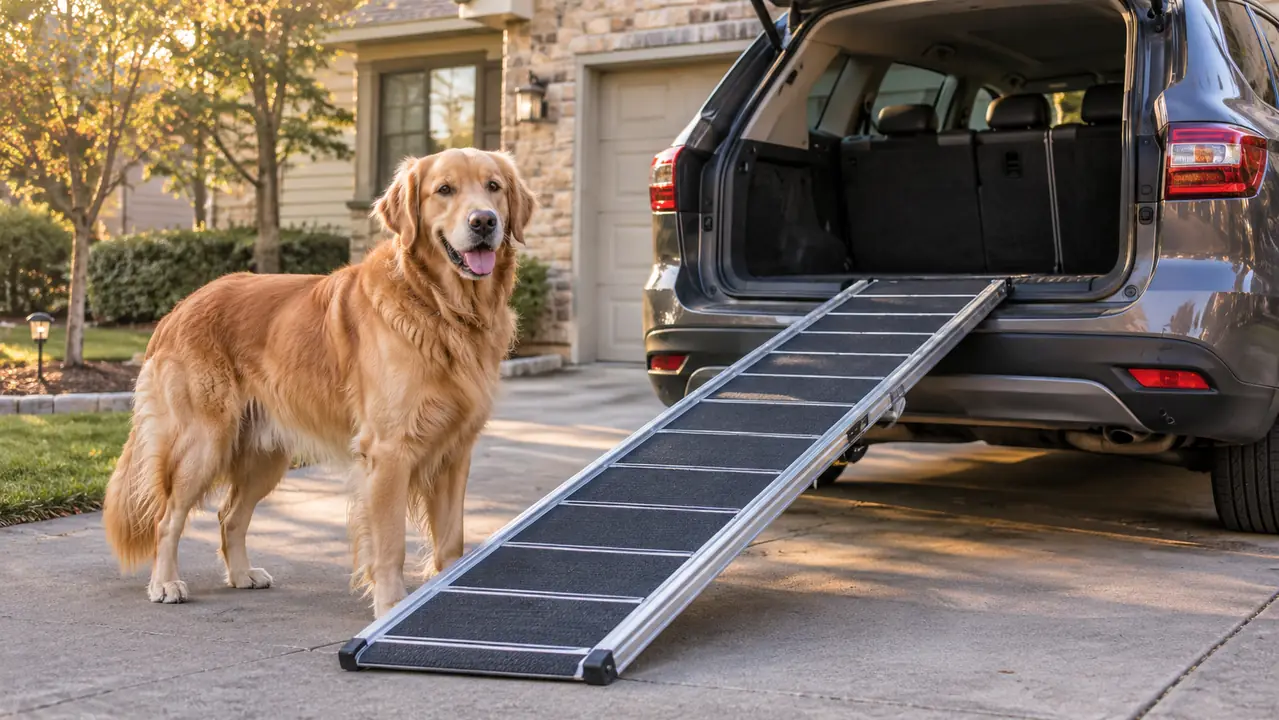
The first time Juniper stood at the back of our SUV and just looked at the bumper, I knew we had crossed a line. She is a 12-year-old golden retriever mix, about 64 pounds, and she has arthritis in both hips. For years she launched herself into the cargo area like it was nothing. Then one morning she hesitated. The next week she stopped jumping altogether and waited for me to lift her, which at her weight was getting harder on my back and harder on her dignity. I spent 30 years as a nurse on orthopedic and rehab floors, so I know exactly what repeated impact does to a stiff joint. I also know what happens when a dog decides the car hurts. They stop wanting to go. That is what pushed me to look for a ramp instead of just helping her up.
After six months of daily use, the PetSafe Happy Ride Telescoping Dog Ramp has earned a permanent spot in our hatch. I will walk through what I saw, what I measured, and what I would tell a friend who is trying to decide between this ramp and a set of steps.
The Quick Verdict
A sturdy, wide, adjustable ramp that turned our twice-daily lift into a calm walk. It is heavy and takes a little practice to extend, but for a senior dog with hip arthritis it has been worth every bit of storage space.
Amazon Check Today's Price →If your dog hesitates before the jump, the ramp is the fix
Juniper went from bracing at the bumper to walking up on her own in about a week. See today's price on Amazon and check whether it fits your vehicle's opening.
Amazon Check Today's Price on Amazon →How I've Used It
Our routine is simple. The ramp lives in the cargo area, and on days we head out I pull it out, extend the sections, and set the top edge on the bumper or the tailgate sill. The ramp extends from 47 to 87 inches, which has covered every vehicle we have used it with, from our mid-size SUV to a friend's taller truck. You adjust the length by sliding the sections and locking them with the latch.
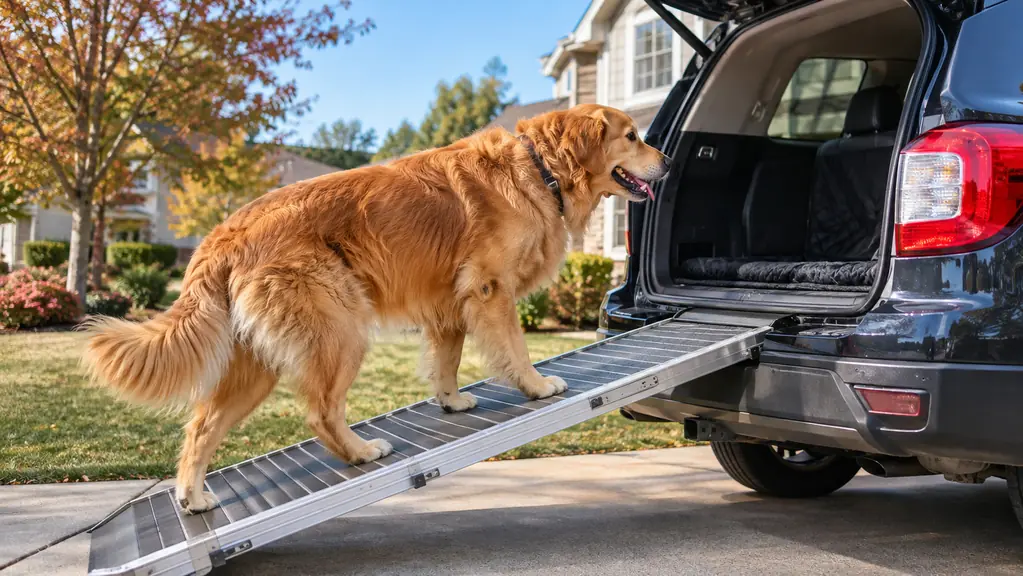
Juniper walks up with her front feet first and then her back end follows, which is the pattern our vet wanted to see. She no longer has to gather herself and leap. She just walks. The high-traction surface gives her feet something to grip even when the ramp is at a steeper angle, and the side rails give her a visual edge so she does not drift off the side. I keep a hand near her flank on the way down because downhill is where she is least steady, but honestly she has needed less help every week.
Before the ramp, I tried everything short of a ramp. A folding step stool from the garage, which Juniper refused to use because the surface was too narrow for her feet. A towel sling under her belly, which worked but needed two hands and left her confused about what was happening. And plain lifting, which I did for longer than I should have. My lower back reminded me every night. The ramp was the first option that let her do the work herself, and that turned out to be the whole difference.
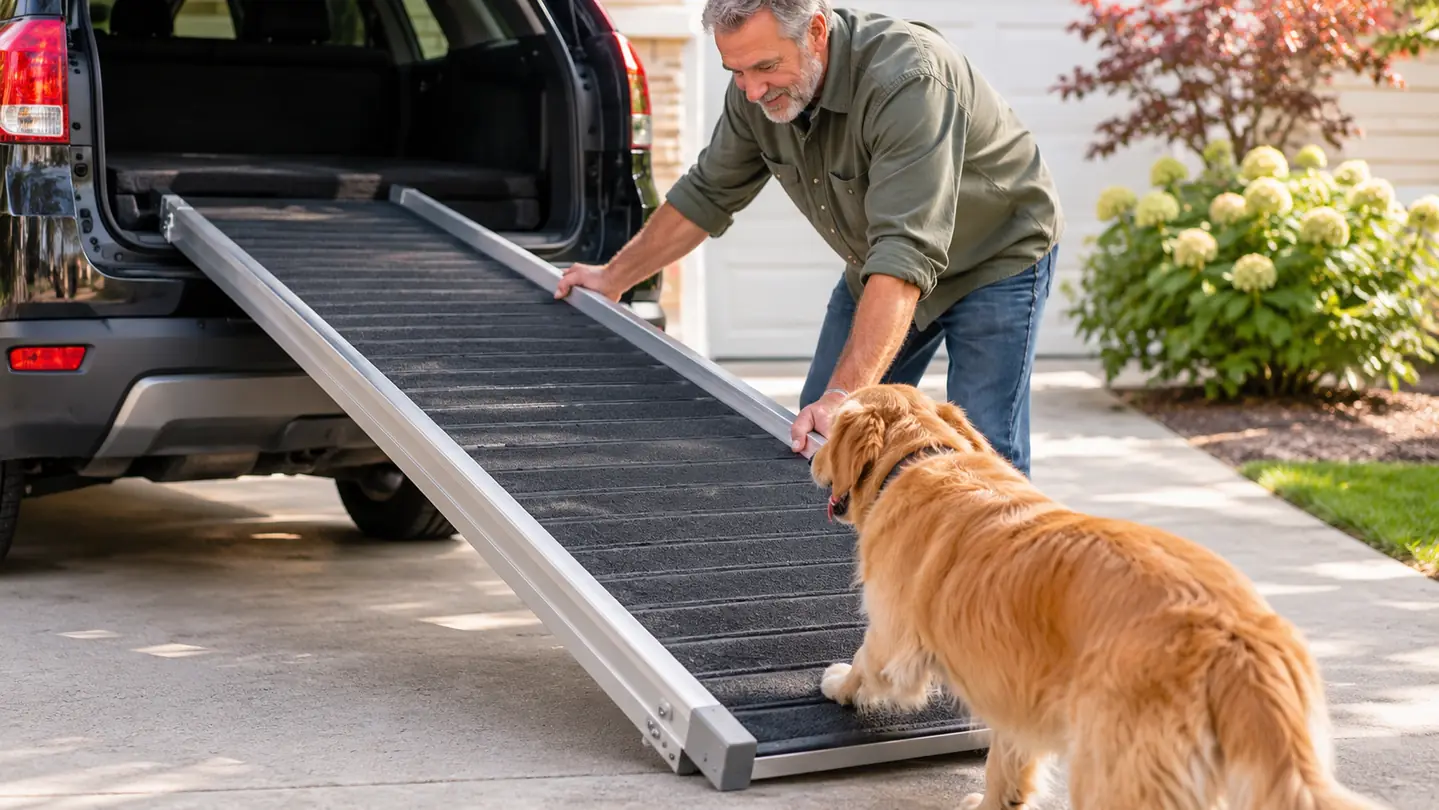
The first morning I set it up, I made the angle too steep. Juniper put her front paws on the ramp, felt the slope, and backed off. I pulled the bottom of the ramp a few inches further out, which flattened the angle, and she tried again. That taught me the lesson I still use: the angle matters more than the length. Now I always set the top edge on the sill and then adjust the bottom until the slope looks like a gentle walk rather than a climb.
I also use it for the three wooden steps down to our back yard on days when her hips are stiff. It is not a perfect fit for that job because the ramp is long, but it works in a pinch. The rubber feet keep it from sliding on the wood, and I like having one tool that does both jobs.
What the Specs Actually Tell You
The PetSafe Happy Ride is an aluminum ramp with a load capacity of 300 pounds, so it is not just for small dogs. Juniper is 64 pounds and the ramp does not flex or bounce under her. The item dimensions are 87 inches long, 20 inches wide, and 4 inches high when fully extended, and the whole thing weighs about 9.7 kg, which is roughly 21 pounds. That weight is the main tradeoff. It is not a featherweight accessory you toss over your shoulder. It has a convenient carry handle, and I do use it, but I would not want to carry it a long distance.
The 20-inch width is the spec I would not trade. Juniper's stride is not what it used to be, and on a narrow ramp she has to place each foot with care. At 20 inches she has room to correct herself without stepping off the edge. The 4-inch height of the ramp body also matters. It sits low enough that the transition from the ramp to the bumper is almost flat, so there is no lip for her back feet to catch on. Those two numbers, more than the length, are why she stopped hesitating.
The aluminum construction is what makes the weight worth it. It does not rust, it does not warp in the North Carolina heat, and it has held up to daily use for months without any loose sections or wobble. The one-year warranty against materials and workmanship gives me some peace of mind, though I have not needed it.
The latch took a little practice. On the first few uses I had to fiddle with it to get the two sections to line up, but after a week it became second nature. I can extend the ramp in under a minute now. The carry handle is placed so the ramp balances like a suitcase, and I carry it from the hatch to the bumper without any trouble. It is the kind of thing you only notice when it is done well.
The included components are the ramp itself, the carry handle, and the latch. There is no complicated setup and no tools required. You extend it, lock it, and it is ready. For someone like me who is not handy, that matters.
What I measured over six months was not a sudden fix. It was a dog who stopped hesitating at the bumper and started walking up on her own.
How Juniper's Mobility Changed Over the Months
I kept a rough log because that is what 30 years of nursing does to you. In the first week, Juniper needed me to stand beside her and put a hand on her hip for balance. By week three, she was walking up with just my voice. By month two, she would trot up the ramp when she heard the latch click, because she had learned that the ramp meant a ride.
The log started in early May, the week the ramp arrived. Day one was not pretty. She walked up on the second try, but only with a hand on her hip and a treat waiting at the top. Day four she paused halfway up, looked around, and then finished on her own. By the end of the first week the pause was gone. I wrote 'no pause' in the margin and underlined it, which is the nurse in me. The damp mornings in late May were the hardest. She would stand at the bottom of the ramp and refuse, and I would wait ten minutes and try again. By August, even the damp mornings were easier. I cannot separate how much of that is the ramp and how much is the warmer weather, but the ramp removed the part of the car that hurt.
I also started watching how she got out. Before the ramp, she would stand at the edge of the hatch and wait for me to lift her down, which meant bending into the cargo area at an awkward angle. Now she turns around and backs down on her own, one step at a time. She only asks for help on the hardest days, like after a cold night when her hips are stiff.
The downhill direction is where I still watch her. Coming down, her weight shifts forward and her arthritic hips have to control the descent. The ramp's high-traction surface helps, and the side rails give her something to orient against. I would not say she is completely steady yet, but she is steadier than she was on the bare bumper, and she no longer refuses to get out of the car.
The biggest change was not physical. It was behavioral. Juniper stopped associating the car with pain. She used to hang back when I opened the hatch. Now she comes when I call her, because the ramp has made the car a place she can get into and out of without hurting. For a dog with arthritis, that willingness to keep moving is the whole point.
Who This Is For
This ramp is for anyone with a dog who hesitates before jumping into a car, truck, or SUV, especially a senior dog with joint issues. It is also for the people lifting those dogs. I lifted Juniper for a couple of months before I bought this, and my lower back paid for it. If your dog is over 40 pounds and starting to slow down, a ramp is not a luxury. It is a way to keep your dog mobile and keep yourself out of the chiropractor's office.
It is also for people who have more than one vehicle or who travel. Because the ramp extends from 47 to 87 inches, it adapts to different heights. We have used it on our SUV, a friend's truck, and even a minivan, and the adjustable sizing meant we never needed a second ramp.
Last month we took Juniper to visit a friend whose truck sits higher than our SUV. I packed the ramp hoping it would reach, and it extended to the full 87 inches with the top edge resting on the tailgate and inches to spare. My friend watched Juniper walk up without help and said she could not believe a dog that stiff could do that on her own. We also used it on a beach trip in May. The parking lot was gravel, and the rubber feet gripped well enough that the ramp did not slide even when Juniper stepped on at an angle. That is the moment the PetSafe ramp stopped being an experiment and became a permanent part of our routine.
The ramp is also for the dog who is not in pain yet. Juniper's arthritis was diagnosed around age 10, and I wish I had bought the ramp then instead of waiting until she could no longer jump. Every jump she made in that stretch was impact on hips that were already wearing down. If your dog is middle-aged and still jumping fine, a ramp is cheaper than the surgery you might be avoiding.
Who Should Skip It
Skip it if you have a very small dog who can be carried easily, or if your dog has a condition where walking on an incline is not recommended. Our vet was clear that Juniper's arthritis benefits from low-impact exercise, and walking up a gentle ramp is low impact. But a dog with a spinal issue or a recent surgery may need a different setup, so talk to your vet first.
Also skip it if you need something permanently mounted to your vehicle or your porch. This is a portable ramp, not a fixed one. And if storage space is a real problem, the 87-inch length when extended and the folded size are worth measuring before you buy. It fits in our cargo area, but it is not small.
One more honest note about the weight. The ramp is about 21 pounds, so if you have limited upper body strength, think about where it will live. I keep mine in the cargo area, which means I only carry it a few feet at a time. If you would have to haul it from the garage to the car every day, that weight will matter more than it does for me.
What I Liked
- 300-pound load capacity handles large dogs easily
- Aluminum build feels solid and has not rusted or warped
- Extends from 47 to 87 inches to fit cars, trucks, SUVs, and minivans
- High-traction surface and side rails give a senior dog confidence
- Rubber feet keep it from sliding on pavement, wood, or a tailgate
- Carry handle and latch make it portable once you get used to the weight
Where It Falls Short
- At about 21 pounds, it is heavy to carry any real distance
- Takes a little practice to extend and lock the sections smoothly
- Long when extended, so it needs a decent amount of storage space
- Downhill descents still need a human hand nearby for a stiff dog
What I Would Tell a Friend
If you are standing in the driveway watching your dog look at the bumper and then look at you, that is the moment to buy the ramp. Not next month. Not after the vet visit. The longer a dog practices the jump, the more they learn to dread it, and that dread is harder to undo than the joint stiffness.
I would also tell you to practice with the ramp on flat ground first, before you ever put it on the car. Let your dog walk across it in the living room with treats. That way the first time they see it on the bumper, they already know it is safe. It took Juniper about three indoor sessions before she was confident, and then the car was easy.
Before you order, take two measurements. The height of your vehicle's opening tells you how long the ramp needs to be, and the width of the cargo area tells you whether the folded ramp will live where you want it to. Both took me five minutes with a tape measure, and they saved me from guessing. The ramp extends to 87 inches, so it will reach almost anything, but knowing your numbers makes the first day easier.
Give your dog the car rides back
If Juniper can learn to walk up a ramp at 12 with arthritic hips, your dog can too. Check today's price on Amazon and see if the PetSafe Happy Ride fits your vehicle.
Amazon Check Today's Price on Amazon →