
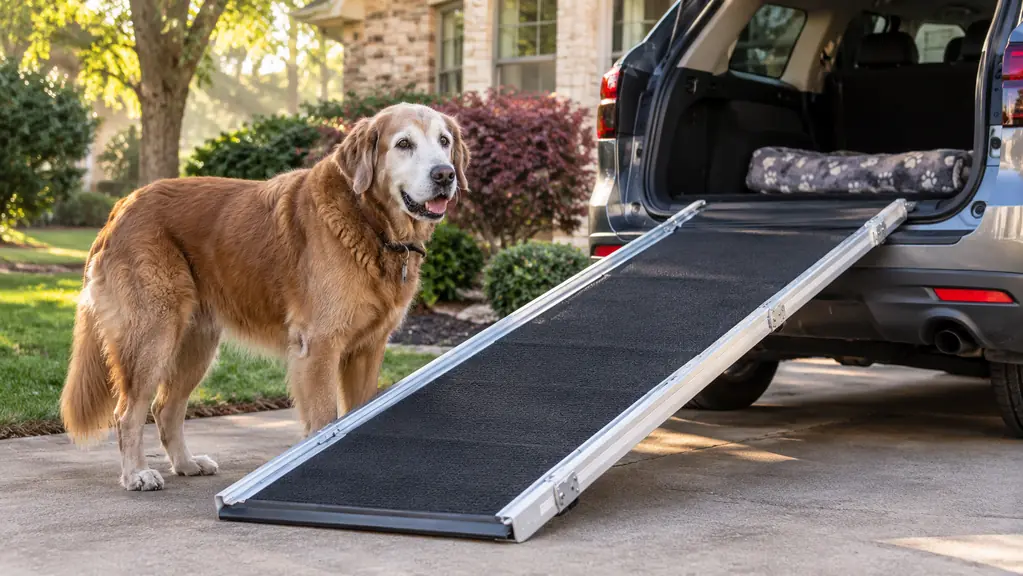
When Juniper turned 12, the jump into the back of our SUV stopped being a jump. She would stand at the bumper, front paws up, then look back at me as if to ask whether I was sure this was still a good idea. Our vet confirmed arthritis in both hips, and the question became practical: do we give her a ramp or a set of dog steps? I tested both with her over several weeks, and the answer depends on your dog's size, your vehicle, and how much floor space you can give up. Short answer: for a 64-pound dog with sore hips, the PetSafe Happy Ride Extra Long Telescoping Dog Ramp won, and it wasn't close.
That conclusion surprised me a little. Early on I leaned toward steps because they looked less intimidating and I could keep them in the house. Our house is a single-story with hardwood floors and three wooden steps down to the back yard, and Juniper manages those fine, one at a time. The SUV was the problem, because the cargo floor sat higher than any step she faces at home. The morning that settled it was a Tuesday in late September. Juniper had napped longer than usual, and when I opened the hatch she stood at the bumper for almost a full minute before trying. She made it up, but I watched her back legs tremble on the last push, and I decided right there that we were done asking her to jump. Over the next two weeks I borrowed a set of folding steps from a neighbor and set up the PetSafe ramp on alternating days, keeping notes the way I used to chart patients: date, how she approached, whether she hesitated, how many seconds the climb took. The pattern showed up by day four and never changed. On steps she hesitated on six of the ten days. On the ramp she walked up without stopping on nine of the ten. That is the kind of number I trust, and it is the reason this review exists.
| PetSafe Happy Ride Ramp | Dog Steps | |
|---|---|---|
| Getting into the vehicle | Dog walks up a steady incline; no jump required | Dog climbs several separate steps, then still has to step up into the vehicle |
| Weight and portability | Telescopes from 47 to 87 inches, aluminum, 9.7 kg, carry handle and latch included | Usually lighter to carry, but bulky and awkward to fit in the vehicle when not in use |
| Stability on the ground | Rubber feet grip the ground; side rails and high-traction surface help prevent slipping | Depends on the design; narrow steps can wobble on uneven ground |
| Storage at home | Folds down to a long, flat piece that leans against a wall | Stacks neatly in a corner or closet |
| Ease for a 64-pound dog with hip arthritis | One continuous incline, easy for a stiff dog to manage | Multiple vertical lifts, harder on sore hips |
| Best for | Large dogs, tall SUVs and trucks, dogs that hesitate to jump | Small and medium dogs, low vehicles, indoor use like beds and couches |
Where PetSafe Wins
The biggest difference I saw was in Juniper's posture. With steps, she had to lift her back end up one level at a time, and each lift put weight on the hip that hurt. With the ramp, she walked up a steady incline and the whole motion looked like walking, not climbing. For a dog with arthritis, that matters. The PetSafe ramp extends from 47 to 87 inches, so it reached our SUV's rear hatch without me having to angle it steeply. A gentler angle means less effort for the dog.
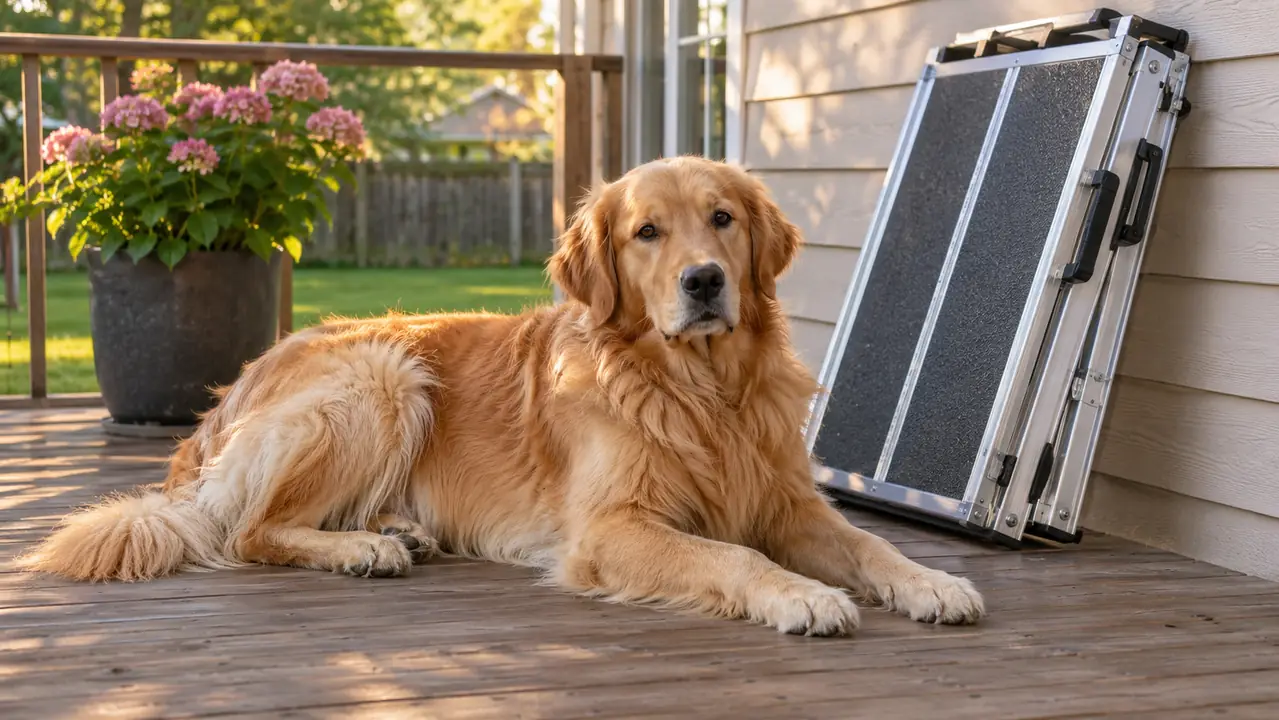
I also appreciated the practical details. The PetSafe ramp is aluminum, weighs 9.7 kg, and has a carry handle and latch, so I could move it from the garage to the driveway without help. The rubber feet held it steady on concrete, and the high-traction surface gave Juniper's paws something to grip even on damp mornings. The side rails gave her a visual edge, and I think they helped her feel less exposed. At 300 pounds of load capacity, it handled her 64 pounds with plenty of margin.
One detail I did not expect to matter: the telescoping adjustment. The ramp extends from 47 to 87 inches, and I found myself changing the length depending on where I parked. On the street, where the curb gave us a little extra height, I shortened it. In the driveway, I extended it fully. The latch held firm each time, and the whole adjustment took under a minute. For a 63-year-old who has lifted her share of patients, the 9.7 kg weight was manageable, and the carry handle made it feel lighter than it was. I could set it up, walk Juniper up, fold it back, and stow it in the cargo area before I started the engine. The first time I did the whole sequence without thinking about it, I knew the ramp had become part of our routine.
I also watched for the things that would have made me send the ramp back. Juniper is not a fan of surfaces that move under her feet, so I half expected her to balk at the aluminum. She did not. The high-traction surface gave her enough grip that she never slid, even on the foggy mornings when the ramp was damp. The side rails were tall enough to feel like a boundary without blocking her view of me at the top. And the rubber feet stayed put on concrete, asphalt, and the packed gravel beside our driveway. After six months of daily use, there is no wear I can see on the surface, and the latch still clicks the way it did on day one. That matters to me, because a mobility aid that fails halfway is worse than none at all.
One Saturday in October we drove to the beach boardwalk, which is about twenty minutes from our house. I set the ramp up in the parking lot, and a woman with a small terrier stopped to watch. She asked whether Juniper had always used a ramp, and I told her no, she had learned it at twelve. Juniper walked up, turned around at the top like it was nothing, and the woman said her own dog was getting too old to jump into their truck. I told her the same thing I will tell you: measure the height your dog has to clear, watch her hesitate once, and you will know which one you need. She took a picture of the ramp with her phone, and I hope it helped her dog the way it helped mine.
Skip the jump that hurts her hips
The PetSafe Happy Ride ramp reaches tall vehicles and gives a stiff dog one steady incline instead of a climb. See today's price on Amazon.
Amazon Check Today's Price on Amazon →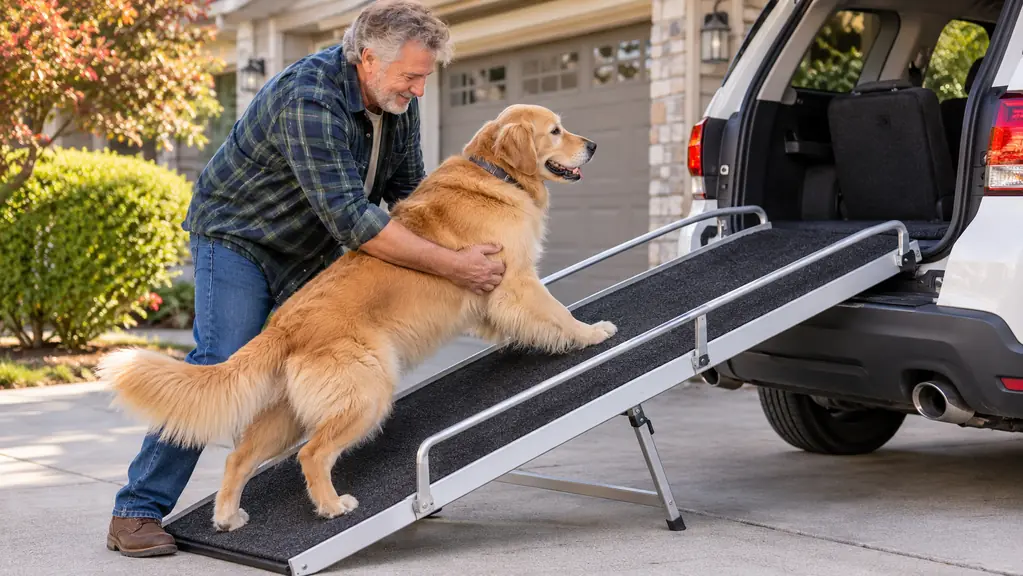
Where Dog Steps Win
I want to be fair, because steps are not wrong for every dog. They take up less floor space when stored, and they can sit permanently beside a bed or couch for a small dog that wants to join you on the furniture. For a dog under 30 pounds with healthy joints, steps are often the simpler, cheaper answer. They also work fine for a low vehicle where the step up is small.
The problem for us was the size of the job. Juniper is 64 pounds, and our SUV has a tall rear hatch. Steps meant a series of small lifts, and the last one was still a jump into the cargo area. The ramp removed that final jump entirely. If your dog is small, your vehicle is low, or you mainly need help onto furniture, steps may serve you better. For a large dog and a tall vehicle, I would not choose steps.
The steps I borrowed were a three-step folding set, and I want to describe honestly what happened with them. Juniper climbed them fine the first two days, which fooled me into thinking they might work. By day three she started planting her front feet on the second step and pausing. By day five she would only use them if I stood behind her with a hand under her belly. The problem was not the steps themselves, it was the motion. Each step required her to shift her weight onto her rear legs to lift her front end, and that is exactly the motion that hurt. On the ramp, her weight stayed distributed across all four feet the whole way up. I measured the difference the way I used to measure a patient's progress: not in what she could do once, but in what she did reliably, day after day.
Steps do have one genuine advantage in our house, and it is worth naming. We have three wooden steps down to the back yard, and Juniper still uses those every day. A portable set of dog steps can live beside a bed or a couch and give a small dog independence without any setup. For a small or medium dog with healthy joints, that is a real benefit, and I would not talk anyone out of it. But for the specific job of getting a 64-pound dog into a tall SUV, the steps I tried asked her to do the one thing her hips objected to, and the ramp did not. That is the whole argument in one sentence.
Who Should Buy Which
Buy the PetSafe Happy Ride ramp if your dog is large, your vehicle is tall, or your dog already hesitates before jumping. It is also the better choice if your dog has hip or back arthritis, because a continuous incline is easier on sore joints than repeated lifting. Buy steps if your dog is small or medium, your vehicle is low, or you need a permanent fixture beside the couch. And if you are unsure, ask your vet, then consider your dog's weight and your vehicle's height. Those two numbers decide it.
Here is the way I explain it to friends who ask, and it is the same way I used to explain discharge instructions to families. Watch your dog at the bumper. If she puts her front paws up and then pauses before committing, that pause is her telling you the jump hurts. A ramp removes the decision entirely. If she trots up and hops in without a second thought, you may not need either one yet, and you can keep that money in your pocket. The right time to buy is before the hesitation turns into a refusal, because dogs who stop jumping often stop wanting to ride at all.
A few practical notes from six months of daily use. The PetSafe ramp stores flat, so I lean it against the wall in the garage between trips, and it takes up about the same footprint as a long piece of lumber. It fits in the cargo area of our mid-size SUV with the seats up, which matters if you travel with the dog in the car. The one-year warranty against materials and workmanship is the kind of thing I check before I buy anything, and the 4.3-star rating across more than 14,000 reviews on Amazon told me other owners had the same experience I did. As always, talk to your vet before changing how your dog gets around, especially if she is on joint medication or has a new limp. Every dog is different, and what worked for Juniper is a starting point, not a prescription. One more thought on the hardwood floors in our living room: if your dog still wants the couch, a set of steps can earn its place there. Start with the highest thing your dog has to climb, and work down from there.
Give her one steady incline
The PetSafe Happy Ride Extra Long Telescoping Dog Ramp extends to fit your vehicle and folds away when you do not need it. Check today's price on Amazon.
Amazon Check Today's Price on Amazon →