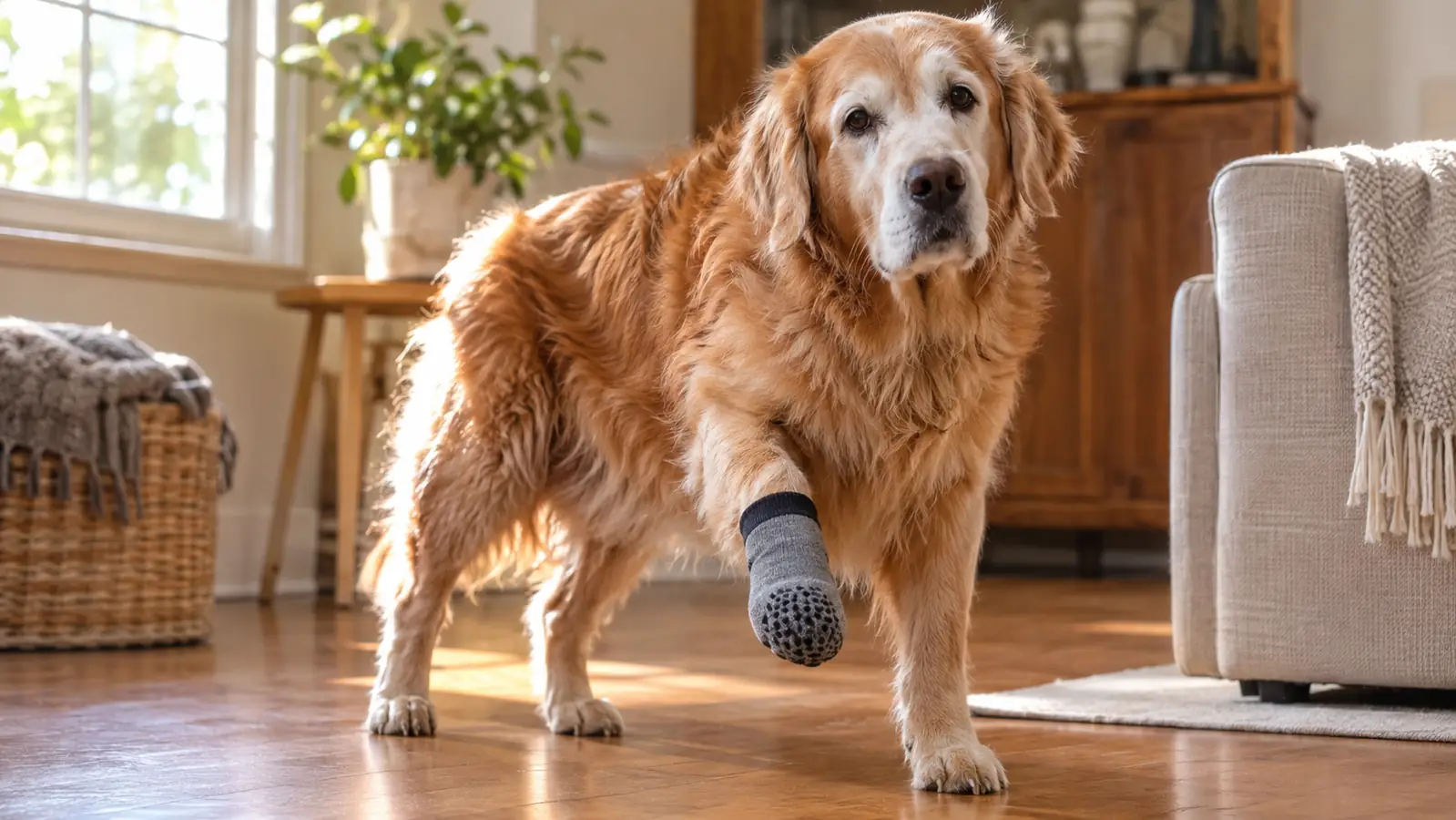
The first time I watched Juniper's back feet slide out from under her on the living room hardwood, my stomach dropped. She is a 12-year-old golden retriever mix, about 64 pounds, with arthritis in both hips, and she had already started hesitating on the back porch steps. That morning she tried to turn around too fast, her hind legs went one way, her body went the other, and she landed hard on her hip. She got up right away, shook herself off, and looked at me like nothing happened. But I spent 30 years on orthopedic and rehab floors as a registered nurse, and I knew exactly what that fall meant for an older dog with joint pain. One bad slip can undo weeks of progress. So I started looking for a practical fix, and what I landed on was a pair of DOK TigerToes dog socks and a simple five-step routine that made our floors feel safe again.
I want to be clear about one thing before I go further: I am not a veterinarian, and nothing in this guide replaces a conversation with your own vet. If your senior dog is suddenly slipping more, limping, or struggling to get up, that is a medical question first. What I can share is what worked for Juniper in our own home, the way I would have explained it to a patient's family: plain words, what to watch for, and what is realistic.
The socks that stopped Juniper's hardwood slides
DOK TigerToes dog socks use a performance grip that keeps traction even when the sock twists, which matters more than you would think once a dog starts walking. They come in a set of four, sized for paws 2.5 to 2.8 inches wide, and they are made to be machine washed.
Amazon Check Today's Price on Amazon →Step 1: Watch Your Dog on the Floor Before You Buy Anything
Before I ordered a single sock, I spent two days just watching Juniper move through the house. I wanted to know which paws slipped most, which turns gave her trouble, and which rooms she avoided entirely. For her, it was the back feet that went out on the hardwood in the hall, especially when she changed direction. She also started bracing herself at the edge of the living room, planting her front feet and pausing before she committed to walking across.
That observation mattered because it told me the problem was traction, not weakness alone. Her hips were stiff, sure, but the floor was robbing her of the little grip she had. I also checked her paw pads for cracks, torn nails, or matted fur between the toes, because a sock over a sore paw is not a kindness. If you see redness, swelling, or a limp that does not improve, call your vet before you try any product.
This is also the moment to look at the rest of the house. I ran my hand over the hardwood and found a few rough spots near the back door where the finish had worn thin. I put down a runner in the hall and a larger rug in the living room, but I did not try to cover every inch of floor. Dogs need a path they can trust, not a house wrapped in carpet. The socks were the missing piece, not the whole solution.
Step 2: Measure the Paw and Pick the Right Size
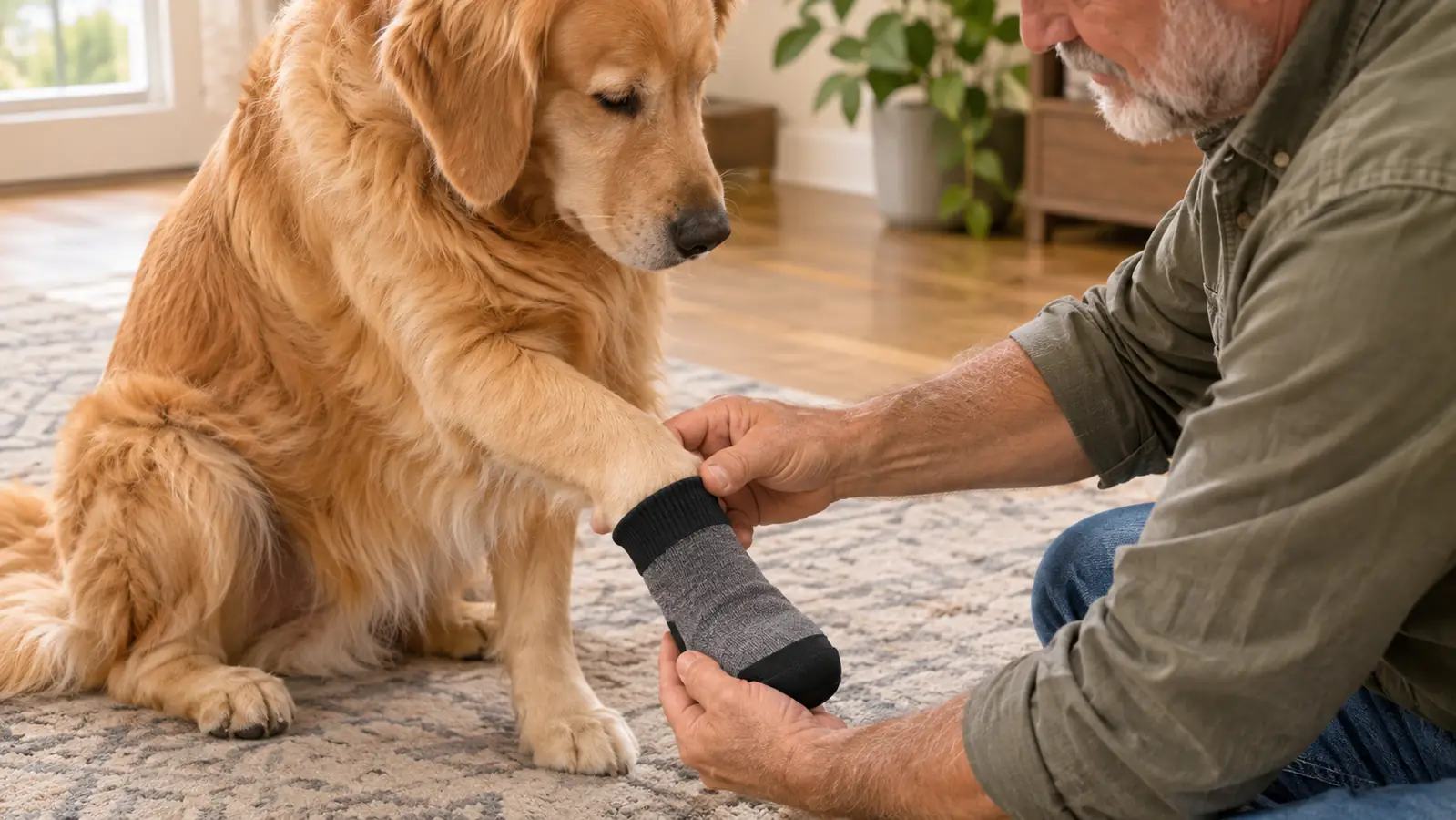
DOK sizes its TigerToes socks by paw width, and the Large size fits paws 2.5 to 2.8 inches. Juniper's front paws measured right at 2.7 inches across the widest part, and her back paws were a touch narrower, around 2.5. I ordered the Large set of four and they fit her front and back paws without any of them sliding off mid-walk.
To measure your own dog, have them stand on a piece of paper and gently press down on the paw so the toes spread the way they do when bearing weight. Mark the widest point on each side and measure across. Do this for a front paw and a back paw, because many dogs, like Juniper, have slightly different sizes front and back. If your dog lands between sizes, I would size up rather than down. A sock that is too tight can bunch up between the toes, and a sock that is too loose will end up on the floor.
One thing I appreciated about the DOK TigerToes is that they close with a hook and loop strap in addition to being pull-on. That gave me a way to adjust the fit around Juniper's ankle so the sock stayed put without squeezing. She has always hated anything tight around her legs, so I kept the strap snug enough to hold, loose enough that I could still slide a finger underneath.
Step 3: Introduce the Socks Slowly, One Paw at a Time
The biggest mistake I see people make with any new piece of dog gear is strapping all of it on at once and expecting the dog to act normal. Juniper is a good-natured dog, but she is also 12 years old and set in her ways. The first time I held up a sock, she sniffed it, looked at me, and sat down. So we started with one front paw.
I put a single DOK TigerToe on her right front paw, gave her a treat, and let her walk around the kitchen for a few minutes. She lifted the paw high a few times, the way dogs do when something is new, but she did not try to chew it off. The next day we did two front paws. The day after that, all four. By the end of the first week, she would stand still and lift each paw in turn while I slid the socks on, because she had learned that socks meant a walk outside or a treat afterward.
Keep the first few sessions short and positive. Five minutes indoors is plenty. If your dog tries to pull the socks off, distract them with a treat or a favorite toy, and take the socks off before they get frustrated. You want the sock to feel like a normal part of the day, not a punishment. And check each paw after the first walk to make sure nothing has rubbed or bunched up.
Step 4: Let the Grip Do the Work on Real Floors
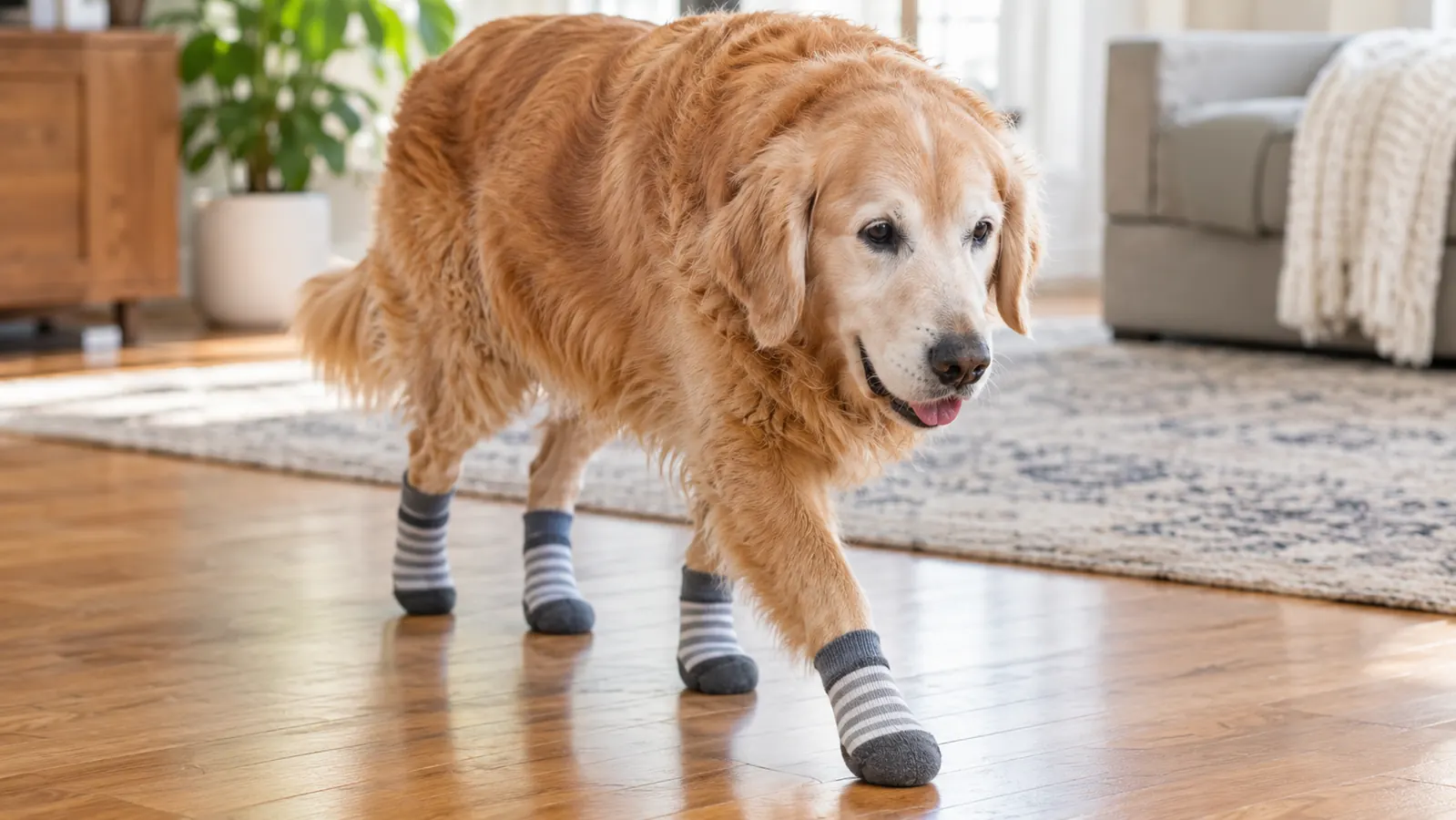
Once Juniper was comfortable wearing all four socks, I let her walk the full length of the hall and back across the living room. The difference was immediate. Her back feet stopped sliding out sideways when she turned, and she started walking with a longer, more relaxed stride instead of the short, careful steps she had been taking. The DOK TigerToes have a performance grip that is engineered to provide traction even if the sock twists while the dog is wearing them, and that mattered for Juniper because she does not always walk in a perfectly straight line.
I also noticed she was willing to go into the kitchen again, where the floor is slickest, without bracing herself at the doorway. She still walked a little slower than she did five years ago, of course. The socks do not cure arthritis. But they gave her back the confidence to move around her own home, and for a senior dog, that confidence is worth a great deal.
A few practical notes from our first weeks: the socks stayed on best when I made sure her paw pads were clean and dry before putting them on. Damp fur makes any sock slide. I also trimmed the fur between her toes, which gave the hook and loop strap a cleaner surface to grip. And on days when she had been outside in the wet grass, I wiped her paws and let them dry before we came back inside.
Step 5: Build a Daily Routine and Watch for Wear
Juniper now wears her DOK TigerToes every morning after her first trip outside, and she keeps them on for most of the day. It took about two weeks for the routine to feel automatic. I keep the socks in a small basket by the back door, next to her leash, so putting them on is part of the same sequence as getting ready for a walk. She sits, I slide on all four socks, and we go.
Because the socks are machine washable, I wash them once or twice a week depending on how much time she spends outside. I use a gentle cycle and air dry them, and after several months of daily use they still fit the same way. I check the grip pattern on the bottom of each sock every time I wash them. If the grip ever wore smooth or the fabric started to thin, I would replace them, because a sock with no grip is just a foot covering.
I also keep an eye on how Juniper moves when she is not wearing the socks. If she started slipping again even with them on, or if she seemed more hesitant than usual, that would be a sign to call our vet. The socks are a tool for managing a symptom, not a treatment for the underlying joint changes, and I never want to mistake one for the other.
What Else Helps
The DOK TigerToes did the most for Juniper's footing, but they were not the only change I made. I put non-slip runners in the hall and a large rug in the living room, and I kept her nails trimmed short so they would not catch on the floor. I also talked to our vet about her arthritis management, because a dog with comfortable joints is a dog who can use her grip. If your senior dog is slipping, I would look at the whole picture: floor surfaces, nail length, paw pad condition, and pain management. The socks handle the traction, and the rest of the routine handles everything else.
The first time Juniper walked the full length of the hall without her back feet sliding out, I actually stopped and watched her do it twice. That was the moment I knew the socks were doing their job.
One more thing I would tell any owner of a senior dog: be patient with the process. The first week, I was not sure Juniper would ever accept the socks. By the third week, she was lifting her paws for them. Older dogs can learn new routines, they just need a little more time and a lot more treats.
Give your senior dog a floor they can trust
DOK TigerToes dog socks are sized for large paws, come in a set of four, and are built with extra grip for exactly the kind of slipping that scared me into action. They are machine washable, easy to put on, and they made a real difference for Juniper in the first week.
Amazon Check Today's Price on Amazon →